



Every licensed slot ships with a number baked into its code. That number tells you, before you wager a dollar, how much of your money the game is designed to keep over the long run. It is called RTP, and knowing how to read it is one of the few genuinely useful things a player can do before pressing spin.
This guide explains what is RTP, how to calculate it, what house edge means in relation to it, and, critically, why the figure published on a provider’s website might not be the one running at the casino where you’re actually playing.
What Does RTP Mean?#
RTP (Return to Player) is the percentage of all money wagered on a slot that the game is mathematically designed to return to players over time. A slot with 96% RTP will return, in aggregate across millions of spins, $96 for every $100 wagered. The casino keeps the remaining $4. That $4 is the house edge.
A few things that RTP is not:
- It is not a guarantee for your session. In a single hour or a single day, your actual return can land far above or below the stated percentage.
- It is not measured per player. It is a statistical average across every spin the game has ever processed, at every casino where it runs.
- It does not shift based on time of day, how long you have been playing, or whether the machine is “due” for a win.
Understanding what is RTP also means understanding what the number reflects. Developers calculate it before a title ships, using simulations of tens of millions (sometimes billions) of spins against the full paytable. Once set, it does not drift unless the operator is running a different configured variant, which is covered in its own section below.
How Is RTP Calculated?#
The formula is simple:
RTP = Total Payouts ÷ Total Wagers × 100
Example: A game processes $10,000,000 in lifetime bets and pays out $9,600,000 in prizes. RTP = $9,600,000 ÷ $10,000,000 × 100 = 96%.
For a player trying to verify a game’s claimed figure, the realistic approach is to check the source, not track your own results. Developers publish RTP on their official sites, independent testing labs certify the math, and licensed casinos display the figure in each game’s info panel. Running enough spins personally to verify statistical accuracy would require tens of millions of rounds; short-session tracking tells you nothing reliable about the underlying number.
What you can calculate, given a stated RTP, is your expected long-run cost per session:
Expected loss = Total amount wagered × (1 − RTP)
If you spin $5 per round at 200 rounds per hour on a 96% RTP title: $1,000 wagered × (1 − 0.96) = $40 expected hourly cost. That $40 is not guaranteed to land that way in any given session, because volatility distributes wins unevenly, but it gives you a concrete benchmark for bankroll planning.
RTP vs. House Edge: Two Sides of the Same Number#
House edge is the inverse of RTP, expressed from the operator’s perspective:
House Edge = 100% − RTP
A slot with 96% RTP gives the casino a 4% edge. The two numbers describe the same mathematical reality from opposite directions. RTP is the player’s share; house edge is the casino’s margin per dollar wagered.
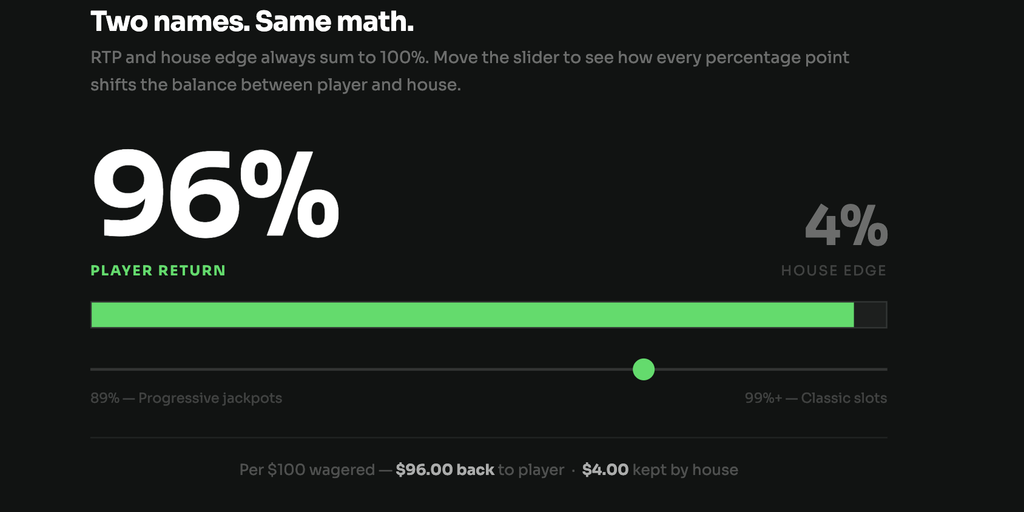
The table below shows how RTP tiers map to typical game types in licensed online casinos:
| RTP Tier | House Edge | Typical Game Type |
| 98%-99%+ | 1%-2% | Classic / heritage video slots (e.g. Mega Joker at 99%, Blood Suckers at 98%) |
| 96%-97.9% | 2%-4% | Most modern video slots (e.g. Starburst at 96.1%, Gonzo’s Quest at 96%) |
| 94%-95.9% | 4%-6% | Lower-tier video slots; common on some bonus-heavy titles |
| 89%-93% | 7%-11% | Progressive jackpot slots |
| Below 89% | 11%+ | Land-based machines; rare in licensed online environments |
Progressive jackpot slots sit at the bottom of the RTP scale because a portion of every bet feeds the prize pool rather than regular payouts. Players trading average return for a shot at a large jackpot is a different transaction. The math is different, not inherently unfair.
Why Doesn’t My Session Match the Listed RTP?#
Short-term results diverge from stated RTP because of volatility, and that divergence is built into the design, not a bug.
Volatility (also called variance) describes how a game distributes its payouts across spins. It is independent of RTP: two games can share a 96% RTP but feel completely different.
- Low volatility: Frequent, smaller wins. Your balance stays close to its starting point for longer. The losses, when they come, are gradual.
- High volatility: Rare, large wins. Long stretches with little return, then a big payout that accounts for a significant portion of what the RTP “owes.” The same 96% might only arrive in a handful of hits across thousands of spins.
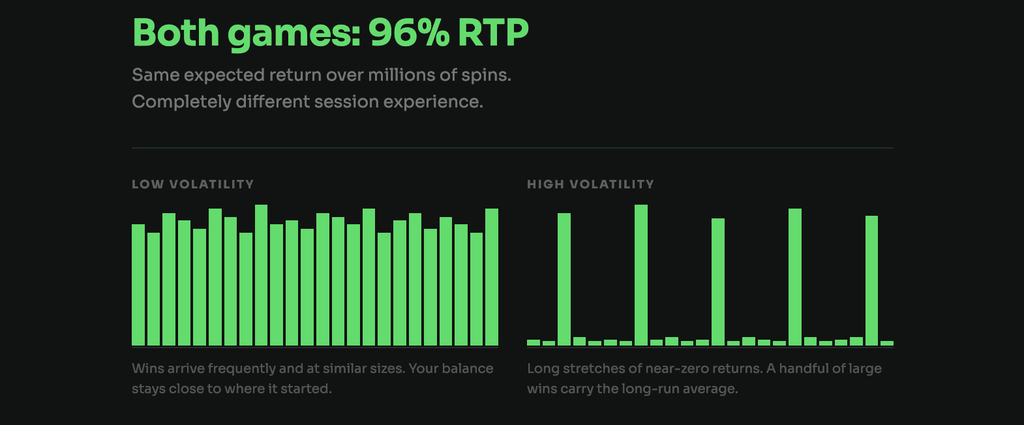
The shorter your session, the more volatility dominates the outcome. The longer you play, the closer your actual return drifts toward the stated RTP. Most players never log enough spins for the math to fully converge.
RTP is useful for comparing games before you play. It is not a forecast for your next hundred spins.
Where Can You Find a Slot’s RTP Before Playing?#
Three sources are reliable, in roughly this order of trust:
1. The in-game info panel. Every regulated slot includes an information or help screen, accessible before or during play. This is where the active RTP for that specific game, at that specific casino, appears. It is the most important source to check because, as the next section explains, operators can sometimes run different configured variants of the same title. The in-game panel always reflects what is actually running.
2. The provider’s official website. Studios like NetEnt, Play’n GO, Pragmatic Play, and Microgaming publish RTP data on their own game pages. These show the certified default or the full range of available configurations. If a game has multiple RTP tiers, the provider’s page lists them.
3. Independent RTP databases. Third-party databases aggregate provider-published figures, cross-check them, and flag discrepancies. They are useful for discovering high-RTP titles across a large library, but may lag real-time configuration changes. Treat them as a starting point, not the final word.
What to avoid: trusting a figure from a review without a cited source, or assuming the number from a Google search matches what’s running at your casino today.
Can Casinos Change a Game’s RTP?#
Yes. Many modern slots are built with multiple RTP configurations, and operators choose which one to run.
A Pragmatic Play title published at 96.5% might also have a 94.5% variant. Some providers offer three or four tiers. The “default” figure on a third-party database may not match what is active at the casino where you are playing.
This is not hidden from players: the in-game info screen always shows the active configuration. But it does mean checking RTP once, from a generic source, is not enough. The correct habit is to open the game’s info panel before your first bet.
Providers with the most transparent practices, including NetEnt, Play’n GO, and Big Time Gaming, publish their full configuration ranges publicly and use fixed RTPs for many of their titles, which removes operator-level adjustment entirely. PG Soft games, by contrast, use configurable ranges for some titles (Ganesha Gold, for example, has a notably wide range), making the in-game check especially important for that library.
Operators that compete on game quality tend to run higher-tier configurations. It is a differentiator they can advertise, which creates a commercial incentive for transparency that lower-tier sites lack.
How Does Jack (jack.com) Handle RTP Disclosure?#
Jack (jack.com) runs more than 7,000 games from over 150 providers, including Evolution, NetEnt, and Microgaming: all studios that certify their RTPs through independent testing labs and publish those figures on their own websites.
Because Jack sources games from established, audited providers rather than proprietary in-house content only, each game’s RTP is:
- Set by the provider, not freely editable by the casino outside of the provider’s sanctioned configuration options
- Displayed in the in-game information panel of every title, consistent with the platform’s licensing requirements under the CGA
- Independently verifiable against the provider’s own published data
The practical effect: for any title in the Jack library, you can cross-check the in-game RTP against the provider’s official game page. If the active configuration is lower than the provider’s published default, that gap is visible to any player who checks both sources.
Jack runs on a crypto-native platform with no fiat processing. That does not affect RTP math (RTP is universal across currencies), but it does mean the payout chain from a game win to a wallet withdrawal is shorter than at a fiat-plus-crypto hybrid site: fewer intermediary steps between the game’s outcome and the funds reaching you.
Jack was formerly known as Jackbit before rebranding on May 29, 2026. Accounts, balances, and game access carried over automatically; the provider relationships and game library remain unchanged.
RTP Red Flags Worth Knowing#
A few signals that a casino may not be handling RTP straightforwardly:
- No in-game info panel, or one that buries the figure inside multi-page terms
- A game library that does not name its software providers, making independent cross-checking impossible
- Promotional claims about “high payout rates” with no specific RTP figures cited
- RTP figures that differ from the provider’s published configurations with no explanation
None of these individually proves malpractice, but each is a reason to look harder before depositing.
FAQ#
What is RTP in slots, in plain terms?
RTP (Return to Player) is the percentage of all wagered money a slot is mathematically designed to return to players over millions of spins. A 96% RTP slot returns $96 per $100 wagered in aggregate, over the long run, not in any one session.
How do I calculate the house edge from an RTP?
Subtract the RTP from 100. A game at 96% RTP has a 4% house edge. The house edge is the casino’s theoretical margin per dollar wagered.
Can I trust the RTP figure I find on review sites?
Often, but not always. Some slots have multiple configurations, and review sites commonly list the default or highest published figure. Confirm by checking the in-game info panel at the specific casino where you’re playing.
Is a higher RTP always better?
Mathematically, yes. But volatility matters separately. A 98% RTP title with extreme variance might deplete a small bankroll before delivering wins, while a 95% RTP game with low volatility might sustain longer sessions. Both numbers are worth checking.
Does RTP change the longer I play?
No. RTP is fixed in the game’s math model and does not respond to session length, time of day, or individual player history. The intuition that a machine is “due” is the gambler’s fallacy, not a mathematical property.
Where do I find the RTP for a specific game on Jack?
Open the game’s information or help screen before your first spin. For a second check, look up the game on the provider’s official website (for example, netent.com or pragmaticplay.com) to compare the active configuration against the certified range.
The Practical Takeaway#
What is RTP, reduced to its core: a long-run average that tells you how much of your money a slot is designed to keep. It does not predict your next session. It does not guarantee a win. But it gives you the single most reliable mathematical data point available before you spin, and for any player choosing between otherwise similar games, it is the right place to start.
Check the in-game info panel. Cross-reference the provider’s site. Choose games at operators who source from audited studios and make the figure easy to find. The math does not improve just because a casino makes RTP harder to locate.
If slot play is affecting your time, budget, or wellbeing in ways you did not intend, free and confidential support is available at BeGambleAware.org and GamCare.org.uk.