



Wagering requirements are the single most important number on a casino bonus page — and also the number most players skip over. This article explains exactly what they mean, how to calculate whether a bonus is worth taking, and how Jack (jack.com) structures its offers differently.
What Are Wagering Requirements?#
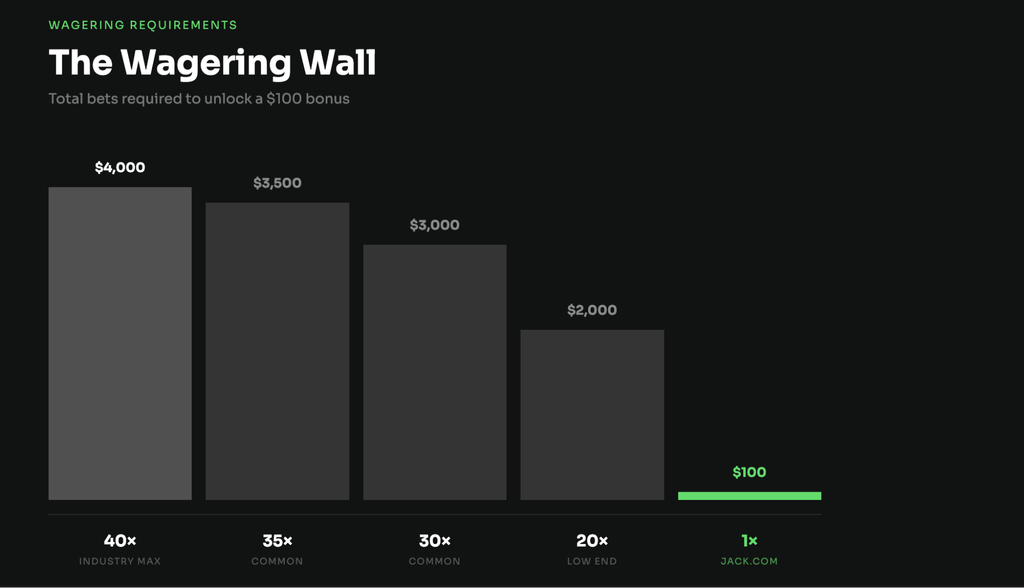
A wagering requirement (also called a playthrough or rollover requirement) is the total bet amount you must place before withdrawing bonus funds or winnings derived from them. It’s expressed as a multiplier: a 30x wagering requirement on a $100 bonus means you must wager $3,000 in real bets before the bonus converts to withdrawable cash.
The multiplier applies to the bonus amount alone on most platforms. On some, it applies to the bonus plus your original deposit — which can double or triple the threshold without the marketing copy making that obvious. A bonus is never “free” in a financial sense; it’s credit that carries a conversion cost.
How Do You Calculate the Real Value of a Bonus?#
Take these two inputs: the bonus amount and the wagering multiplier. Multiply them. The result is the total bets you must place before seeing a penny of bonus money.
A simple example:
- Bonus: $100
- Wagering requirement: 35x
- Total to wager: $3,500
Now layer in game restrictions. Most bonus terms only allow wagering on slots, not table games or live casino. That limits your flexibility and funnels you toward higher-house-edge products. Add return-to-player (RTP) rates — the average percentage of staked money a game returns over time — and a 96% RTP slot is expected to return $96 for every $100 bet. Playing $3,500 at 96% RTP, you’d statistically lose around $140 trying to clear a $100 bonus. That’s before any variance is considered.
Variance matters here. This is where slot volatility becomes a real factor.
Why Does Slot Volatility Make Wagering Harder Than the Math Suggests?#
Slot volatility measures how a game distributes its payouts: high-volatility slots pay less often but larger amounts; low-volatility slots pay smaller amounts more frequently. It’s separate from RTP, which describes the average return across millions of spins.
The problem with high-volatility slots and wagering requirements is timing. A volatile slot might return its RTP accurately over 100,000 spins, but your bonus has an expiry — typically 7 to 30 days. You might hit a dry stretch early, burn through most of your balance before the multiplier is cleared, and find the bonus gone before it ever converted. The math looked fine on paper; the variance killed the execution.
Low-volatility slots reduce that risk by smoothing out returns.
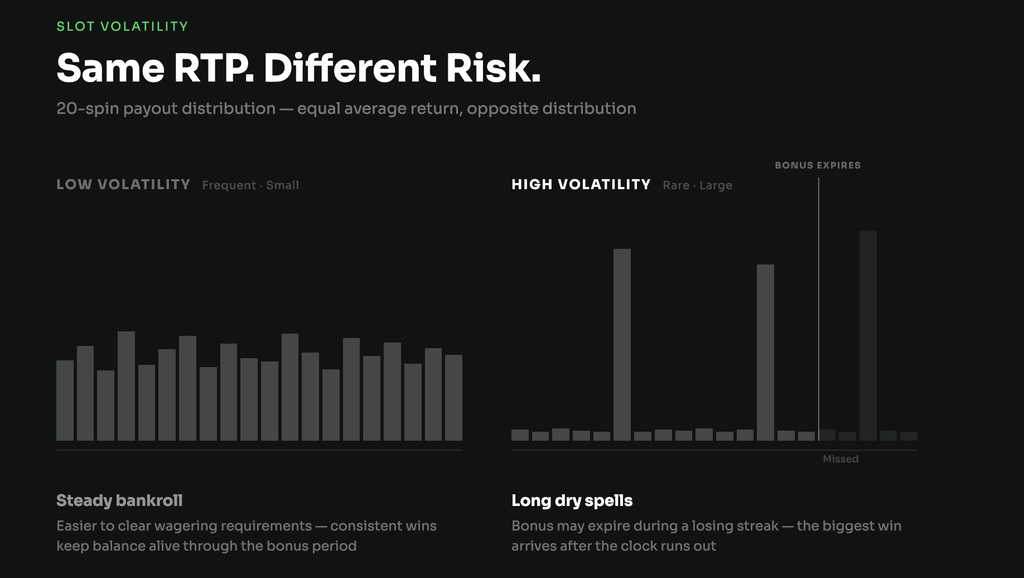
But most casinos don’t separate their slot library by volatility level in the bonus terms, so players are left to research game-by-game. Medium-volatility titles are generally the practical middle ground: enough frequency to keep bankroll alive through a clearing period, enough upside to make the exercise worthwhile.
Short version: the wagering requirement tells you how much to bet; slot volatility tells you how likely you are to survive long enough to actually clear it.
Why Do Casinos Use Wagering Requirements at All?#
The straightforward reason: without them, a casino offering a $100 bonus could immediately receive $100 back as a withdrawal on every signup. The bonus would cost money with no corresponding revenue. Wagering requirements ensure the player engages with the product before cashing out.
The less flattering reason: multipliers set high enough (30x, 40x, or more) become nearly impossible to clear under normal play conditions. At those levels, the bonus functions more as a retention tool than a genuine offer. Players who would have deposited and played anyway are now tied to the platform for longer. Players who came specifically for the bonus often leave before clearing it.
The industry standard sits between 20x and 40x. A 20x requirement on a $100 bonus means $2,000 in wagers — achievable but substantial. A 40x requirement means $4,000 — statistically, you’re expected to lose more than the bonus is worth at most RTP levels.
How Does Jack’s Wager-Free Offer Actually Work?#
Jack (jack.com) structures its welcome offer differently. A minimum $50 deposit triggers 100 wager-free spins, credited within 24 hours.
The term “wager-free” here means spin winnings don’t carry a wagering multiplier. There’s no 30x playthrough on what the spins generate. Winnings are capped at $100, which limits the operator’s exposure on any single player — that’s the trade-off for removing the multiplier.
One condition does apply: the deposit itself, plus any winnings from the spins, must be wagered once (1x) before withdrawal. So if you deposit $50 and win $20 from the spins, you’d need to wager $70 once before cashing out. A single-pass 1x requirement is meaningfully different from a standard 20x–40x playthrough. The math: at 96% RTP, one pass through $70 costs about $2.80 in expected losses. Clearing a 35x requirement on the same amount would cost around $98.
The platform’s rakeback program applies the same principle: rakeback is paid out as withdrawable cash, not bonus credit subject to its own playthrough. That second layer means accumulated rakeback doesn’t restart the wagering clock — it’s money available at withdrawal.
Standard Bonus vs. Jack’s Offer — Side by Side#
| Feature | Industry Standard Bonus | Jack’s Welcome Offer |
| Typical wagering multiplier | 20x–40x | 1x (deposit + winnings only) |
| Applies to | Bonus credit | Deposit + spin winnings |
| Spin winnings | Converted to bonus, then multiplied | No wagering requirement on spins |
| Withdrawal cap on bonus | Usually none, but multiplier prevents early cashout | $100 on spin winnings |
| Expected clearing cost (at 96% RTP, $100 bonus) | $120–$200+ | ~$2–$3 |
| Rakeback | Often bonus credit with its own playthrough | Withdrawable cash, no playthrough |
What Should You Watch Out For With “Wager-Free” Claims?#
The phrase “wager-free spins” has been adopted widely as a marketing term, but it’s not always consistent in practice. Some casinos use it to mean the spins themselves carry no wagering requirement — but then subject the winnings from those spins to a standard 30x or 40x multiplier. That’s not what wager-free means in common usage, and the difference matters.
What to check before claiming any “wager-free” offer:
- Do the winnings from the spins carry a separate multiplier?
- Is there a minimum wagering requirement on the deposit itself?
- What is the winning cap, and does it apply to total winnings or just spin winnings?
- Is there a time limit on using the spins or clearing any remaining conditions?
For Jack’s offer, the relevant terms: spin winnings are capped at $100 and subject only to the 1x pass-through on the full balance (deposit + winnings). The winnings themselves are not separately multiplied.
FAQ#
What’s a reasonable wagering requirement?
Anything under 20x is considered player-friendly in the current market. Most major casinos sit at 25x–40x. A 1x requirement, like Jack’s deposit condition, is at the low end of the scale — closer in structure to a straightforward deposit match than a traditional locked-bonus model.
Do wagering requirements apply to all games?
Usually not. Standard terms restrict which games count toward clearing the multiplier. Slots almost always qualify; live casino and table games often contribute at a fraction (10%–25%) or are excluded entirely. Check the specific terms before playing toward a wagering target with a non-slot game.
Can I lose my bonus if I don’t meet the wagering requirement?
Yes. Uncompleted bonuses typically expire if the wagering isn’t cleared within the offer’s time window — usually 7 to 30 days. When a bonus expires, both the bonus and any winnings derived from it are removed. Your original deposit is unaffected.
What is slot volatility, and why does it affect my bonus?
Slot volatility is a measure of how a game distributes its payouts over time. High-volatility slots produce bigger but rarer wins; low-volatility slots produce smaller but more frequent wins. For bonus clearing, lower volatility is generally safer — you’re less likely to exhaust your balance before the wagering requirement is met.
Does Jack charge fees on withdrawals?
The published processing SLA for withdrawals at Jack is up to 24 hours; independent reviews report typical actual times of 10–18 minutes. No withdrawal fees are documented in the operator’s published terms.
A note on responsible gambling. Bonuses are a feature of the platform, not a guaranteed return strategy. If gambling stops being entertainment and starts affecting finances or wellbeing, support is available through national helplines and organizations like GamCare and BeGambleAware.