


Jack.com collects the least amount of personal data it can get away with under Curaçao law, and asks for more only when a specific event, like a large withdrawal, requires it. That’s the core of Jack.com player privacy: identity checks are triggered by risk, not applied to every account by default, and every deposit and withdrawal runs through crypto rather than a bank account or card tied to your legal name. None of that makes Jack anonymous. It makes Jack a minimal data casino with a narrower data footprint than the fiat-first sites most players are used to, for reasons rooted in how risk-based KYC and crypto payments work. Here’s what Jack collects, what it doesn’t, and where self-custody fits into the picture.
What Is Jack’s Minimal-Data Approach to Player Privacy?#
Jack’s minimal-data approach means an account exists the moment you submit a username, email, and password, with no identity document required to register or make a first deposit. That’s the entire signup form. No date of birth field beyond an age checkbox, no address, no photo ID, no selfie verification, no waiting period. You can deposit roughly 30 seconds after registration.
This isn’t a security gap; it’s a deliberate sequencing choice. Risk-based KYC is a verification model where identity checks are triggered by specific events, like a large withdrawal or an unusual pattern, rather than applied to every user at signup. Jack collects the minimum needed to open an account, then asks for more only if your activity crosses a threshold that regulators or the platform’s own risk systems flag. The result: friction moves from the front door to the exit, the reverse of how most licensed fiat casinos structure the funnel.
What Data Does Jack Actually Collect, and What Doesn’t It Ask For?#
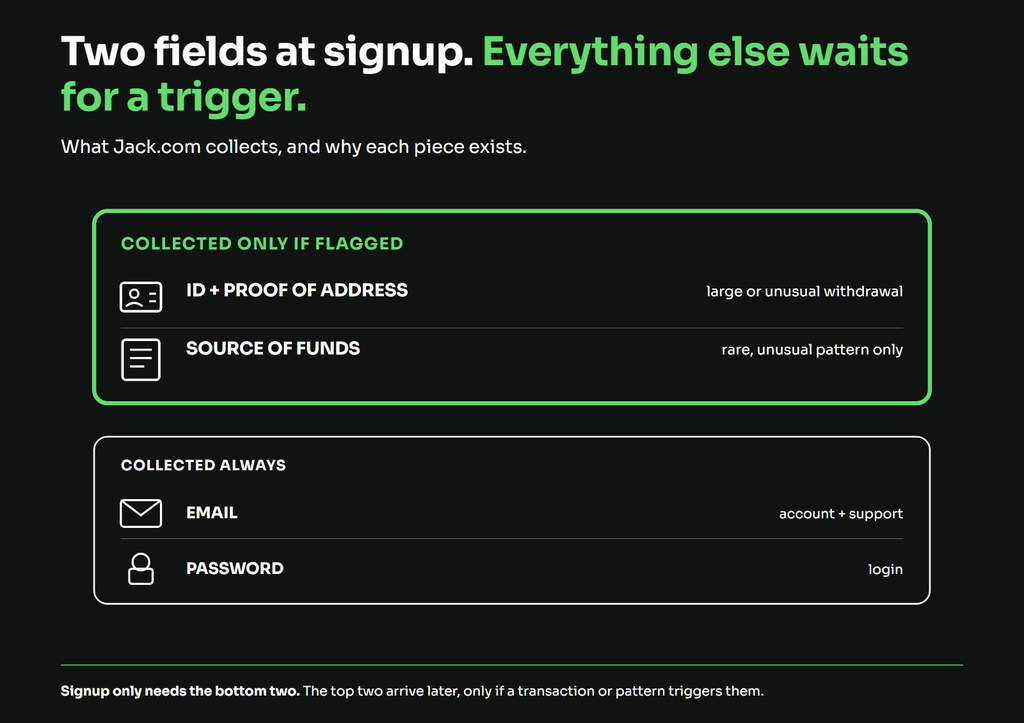
Jack asks for a username, email address, and password at signup, and nothing else unless a later event triggers additional checks. Compare that to a typical licensed fiat casino, which usually wants your full legal name, date of birth, and residential address before you can deposit at all, and sometimes an ID scan before your first withdrawal regardless of amount.
What Jack doesn’t collect at signup:
- Government-issued ID or passport scan
- Proof of address (utility bill, bank statement)
- Card number, bank account, or billing address
- Selfie or biometric verification
- Source-of-funds documentation
What it can request later, tied to specific triggers:
- ID and proof of address, typically at the withdrawal stage on larger or flagged transactions
- A source-of-funds document, if a withdrawal pattern looks unusual
- Additional verification if an account’s activity doesn’t match its history
Every piece of data Jack does collect has a job: an email to secure the account and handle support requests, a password to authenticate logins, and later, if triggered, identity documents to satisfy the anti-money-laundering obligations tied to a Curaçao gaming license. Nothing on that list exists because a standard onboarding form happens to ask for it.
How Does Risk-Based KYC Keep Jack’s Data Collection Minimal?#
Risk-based KYC keeps data collection minimal by tying identity checks to transaction risk, instead of collecting every player’s documents upfront just in case. Curaçao’s gaming law, the Landsverordening op de Kansspelen (LOK), took effect December 24, 2024, and requires licensed operators to run FATF-aligned anti-money-laundering programs. Part of that requirement is identity verification once a transaction crosses a set threshold, generally cited in the NAf 4,000-5,000 range (roughly €2,000-2,500). Below that line, and absent a flagged pattern, an operator has legal room to let an account run on email and password alone.
That’s the regulatory basis for Jack’s model. It also means the trade-off is real, not marketing: a small player who never withdraws a large sum may go an entire account lifetime without submitting a single document, while a player who wins big or withdraws repeatedly at scale should expect the same ID and proof-of-address request any licensed operator would eventually make. Independent reviews and player reports on Trustpilot and Reddit describe exactly that pattern at Jack: complaints cluster around delays and document requests on larger cashouts, not around unexpected checks on ordinary-sized ones.
Why Are Crypto Payments More Private Than Card or Bank Deposits?#
Crypto payments are more private than card or bank deposits because they don’t route through a bank statement, a card network, or a payment processor that logs the transaction against your legal name and address. A bank transfer or card payment to a casino leaves a line item your bank, and potentially your card issuer’s fraud systems, can see and flag. A crypto deposit moves from your wallet to Jack’s system on a public blockchain, without a financial institution sitting in the middle recording the purchase against your identity.
That’s a meaningful difference in who sees what, but it isn’t the same as anonymity. Crypto transactions are pseudonymous: the wallet address and transaction are public and permanently visible on-chain, just not directly labeled with your name unless that address has already been linked to your identity somewhere else, most commonly at an exchange where you bought the crypto and completed its own KYC. Jack.com runs exclusively on crypto, with 17 supported cryptocurrencies and no fiat on-ramp, so there’s no card number or bank account ever entered into the platform in the first place. There’s simply nothing on that end for a bank or card issuer to see.
Does Self-Custody Apply to Jack.com Players?#
Self-custody applies to the wallet you deposit from and withdraw to, not to how Jack holds your balance while you’re actively playing. Self-custody means you, not a third party, control the private keys to a crypto wallet, the direct opposite of a bank holding funds on your behalf. When you fund a Jack.com account, the crypto leaves a wallet you control and lands in Jack’s system; when you cash out, it goes back to a wallet you control. Jack never needs your bank details or card information to move money in either direction, because the entire rail runs through wallets rather than financial institutions.
Self-custody doesn’t mean Jack itself operates as a non-custodial platform. While a balance sits inside your Jack.com account, the operator holds it, the same structure used by the large majority of licensed crypto casinos, and a different model from a fully on-chain “web3” casino where funds stay in a smart contract the player controls at all times. Jack is a crypto-native, custodial casino: broad coin support, no fiat rail, but not decentralized in the strict sense some marketing implies. The distinction matters because it points to where your privacy protection comes from: the wallet-based payment rail, not a claim that Jack never holds your balance.
Minimal-Data Casino vs. Traditional Online Casino: A Side-by-Side Comparison#
| Stage | Traditional fiat casino | Jack.com (minimal-data model) |
|---|---|---|
| Registration | Full legal name, date of birth, address, sometimes ID upload before any deposit | Username, email, password only |
| First deposit | Card or bank details tied to your legal name; billing address often cross-checked | Crypto sent from a wallet you control; no card or bank details entered |
| Time to first deposit | Can involve identity checks before funding is allowed | Roughly 30 seconds after registration |
| Ongoing play | Typically no further checks unless account flagged | Typically no further checks unless account flagged |
| Withdrawal | Standard, often requiring payment-method re-verification | ID/proof of address requested only on large or flagged withdrawals (risk-based KYC) |
| Payment trail visible to | Bank, card issuer, casino | Blockchain (pseudonymous), casino |
Is Jack.com Anonymous?#
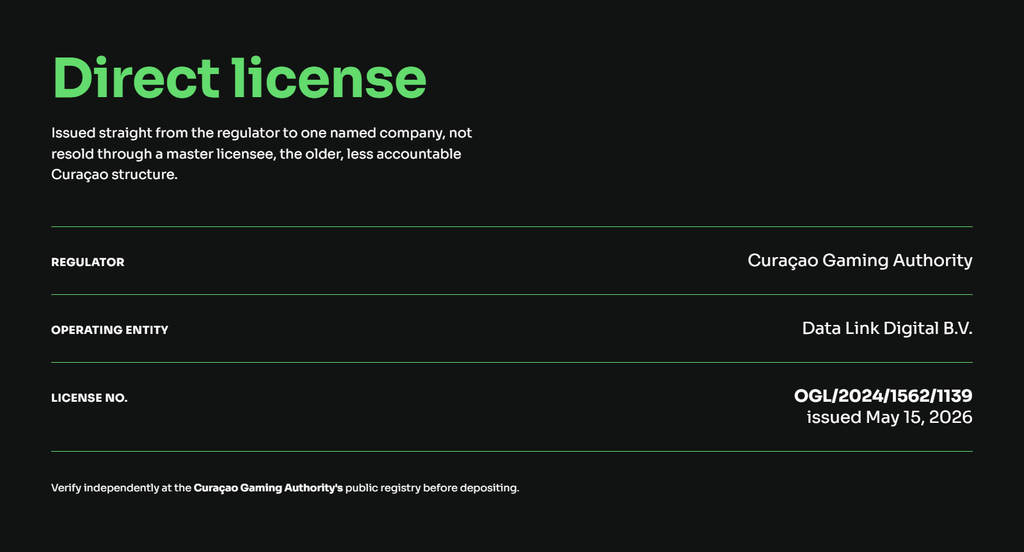
No. Jack.com is not anonymous, and no licensed gambling platform legally can be. Jack (jack.com) operates under a direct license from the Curaçao Gaming Authority (license OGL/2024/1562/1139), held by Data Link Digital B.V. (Curaçao company number 164124), running a crypto casino, sportsbook, and esports book under one account funded exclusively through cryptocurrency. That license carries the same AML and know-your-customer obligations any Curaçao-regulated operator has to meet, including identity verification once a transaction or pattern crosses the LOK’s risk thresholds. Licenses under Curaçao’s post-2024 regime run on renewal cycles, so confirm current status directly on the CGA’s public registry rather than relying on any fixed date.
One more layer applies if you’re in the EU: data protection law follows the player, not the operator’s home address. A Curaçao-licensed platform serving a player in Germany or France is still subject to the GDPR for that player’s data, regardless of where the company itself is incorporated. EU-based players retain the same rights to access, correct, or request deletion of their personal data as they would with any EU-facing service. Jack’s own privacy policy, not this article, is the place to check exact retention periods and how those requests get handled.
Minimal data isn’t a workaround for these obligations, and it isn’t a promise that nobody ever sees your withdrawal history. It’s a sequencing decision: collect less by default, and collect more only when a specific trigger, legal or risk-based, requires it.
Does jack.com require ID to sign up?
No. Registration needs only a username, email address, and password, and you can deposit about 30 seconds later. ID or proof of address can still be requested afterward, typically at the withdrawal stage on larger or flagged transactions, under Jack’s risk-based KYC model.
Is gambling with crypto on Jack.com actually private?
It’s more private than card or bank deposits, since no bank or card issuer sees the transaction, but it isn’t anonymous. Crypto payments are pseudonymous: the wallet and transaction are visible on the blockchain, just not directly tied to your name unless that wallet has been linked to your identity elsewhere.
Does self-custody mean Jack doesn’t hold my funds?
Self-custody describes the wallet you deposit from and withdraw to, which you control. While your balance sits inside your Jack.com account during play, it’s held by the operator, the standard model for licensed crypto casinos, not a non-custodial or fully on-chain setup.
What triggers a KYC check on jack.com?
A large withdrawal or an activity pattern that doesn’t match your account history, consistent with Curaçao’s risk-based AML requirements under the LOK. Ordinary-sized play typically doesn’t trigger any additional document request.
Can I use jack.com without linking a bank account or card?
Yes. Jack.com runs exclusively on cryptocurrency across 17 supported coins, with no fiat deposit or withdrawal option, so there’s no bank account or card number to enter in the first place.
The Bottom Line#
Jack’s version of player privacy isn’t about hiding from regulators; it’s about not collecting data it doesn’t yet need. Minimal information at signup, crypto payments that keep banks and card issuers out of the transaction, and identity checks that arrive only when risk or law requires them add up to a narrower data footprint than most licensed casinos ask for, without stepping outside the license that makes any of it legitimate. Read Jack’s own privacy policy for the specifics of data retention and your rights as a player before you rely on any of this, and remember that a smaller data footprint doesn’t reduce the value of setting a deposit limit or a time-out if play stops feeling like entertainment.