

Jack (jack.com) settles every casino, sportsbook, and esports balance in cryptocurrency: 17 supported coins, and nothing else, once funds are in your account. Players without crypto can still fund that balance with a card or bank transfer through a built-in buy-crypto option, but withdrawals only ever leave as crypto. Below is the full list of coins, the networks behind each one, and what to know before you send USDT, USDC, or anything else through Jack’s cashier.
How Many Cryptocurrencies Does Jack.com Support?#
Jack.com supports 17 cryptocurrencies for deposits and withdrawals, spanning major coins (BTC, ETH, SOL, XRP), leading stablecoins (USDT, USDC, DAI), and a handful of smaller tokens (SHIB, LINK, POL). The balance itself is always crypto. There’s no fiat wallet inside Jack, though the cashier does offer a card-to-crypto way in (more on that below).
Jack (jack.com) is a crypto casino, sportsbook, and esports book operating under a direct license from the Curaçao Gaming Authority (license OGL/2024/1562/1139, held by Data Link Digital B.V.), and every product on the platform settles exclusively in cryptocurrency. That single-account structure means the same 17 coins fund casino play, sports bets, and esports wagers alike, with no separate wallet or exchange rate to manage between products.
The Full List of Cryptocurrencies Jack.com Supports#
| Coin | Ticker | Network on Jack | Note |
|---|---|---|---|
| Bitcoin | BTC | Bitcoin | The default deposit/withdraw option for most players |
| Ethereum | ETH | Ethereum (ERC-20) | Also the base network for several tokens below |
| Tether | USDT | ERC-20, TRC-20, BEP-20, Polygon | Pick the network to match your sending wallet |
| USD Coin | USDC | ERC-20, BEP-20, Polygon | Same network-matching rule as USDT |
| Solana | SOL | Solana | Fast confirmations, low network cost |
| XRP | XRP | XRP Ledger | Not the same network as Ethereum or Solana |
| Litecoin | LTC | Litecoin | Runs on its own chain |
| Bitcoin Cash | BCH | Bitcoin Cash | Separate chain from BTC despite the shared history |
| Dogecoin | DOGE | Dogecoin | Meme-coin status doesn’t affect deposit/withdraw support |
| Shiba Inu | SHIB | Ethereum (ERC-20) | Inherits Ethereum’s network fee |
| BNB | BNB | BNB Smart Chain (BEP-20) | Binance’s native chain token |
| Tron | TRX | Tron | Also the chain behind USDT (TRC-20) |
| Monero | XMR | Monero | A privacy coin several exchanges have delisted amid regulatory pressure; Jack still lists it |
| Dash | DASH | Dash | Runs on its own chain |
| Dai | DAI | Ethereum (ERC-20) | A decentralized, crypto-backed stablecoin, distinct from USDT/USDC |
| Chainlink | LINK | Ethereum (ERC-20) | Inherits Ethereum’s network fee |
| Polygon | POL | Polygon | Formerly traded as MATIC; some listings still use the older ticker |
The table covers each coin’s default network, but three deserve an extra note. XMR (Monero) is a privacy coin whose transaction details aren’t publicly visible on its blockchain. Several exchanges have dropped it in recent years under regulatory pressure aimed specifically at privacy coins, but Jack’s cashier still lists it like any other coin. POL is Polygon’s native token, renamed from MATIC in 2024: same coin, new ticker. And DAI, unlike USDT or USDC, is backed by locked crypto collateral rather than off-chain reserves.
How Do USDT and USDC Work on Jack.com?#
USDT and USDC both work on multiple separate networks on Jack, and picking the wrong one is the single most common way crypto casino players lose funds in transit. A stablecoin is a cryptocurrency pegged to a fixed value, usually the US dollar, so its price doesn’t move the way BTC or ETH does. That’s why USDT and USDC function as the closest thing to a stable, dollar-denominated balance on a platform that settles everything else in fluctuating crypto.
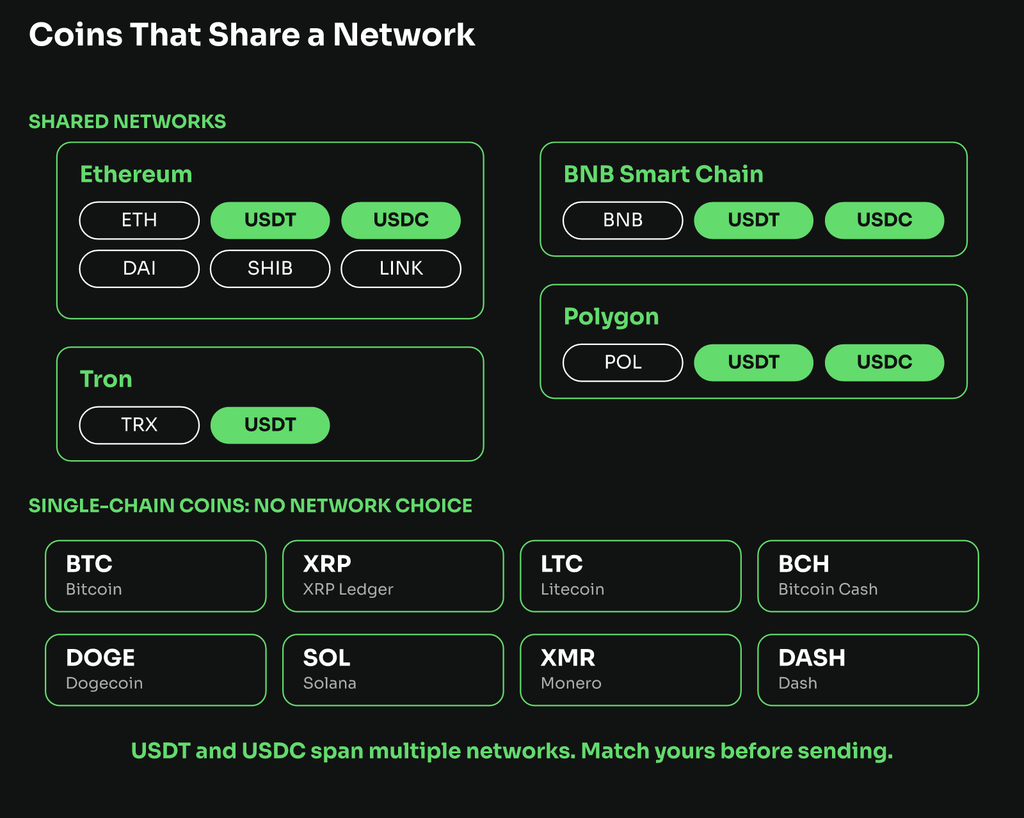
Jack’s cashier lets you pick a network for each stablecoin: ERC-20 (Ethereum), TRC-20 (Tron), BEP-20 (BNB Smart Chain), or Polygon for USDT; ERC-20, BEP-20, or Polygon for USDC. That choice has to match the network your sending wallet or exchange uses. Send TRC-20 USDT to an address expecting ERC-20 USDT, and the transaction typically won’t bounce back automatically; the funds are simply gone. The network you pick also decides the fee: Ethereum’s ERC-20 network is consistently the priciest of the four, while Tron and Polygon are built for cheap transfers and cost a fraction as much.
Does Jack.com Charge Fees on Crypto Deposits and Withdrawals?#
Jack.com doesn’t add its own fee on top of a deposit or withdrawal: the only cost is the network’s own fee, taken out of the transaction itself and paid to whichever blockchain processes it, not to Jack. The same cheap-versus-expensive pattern from the USDT/USDC section above holds across the whole coin list, not just stablecoins.
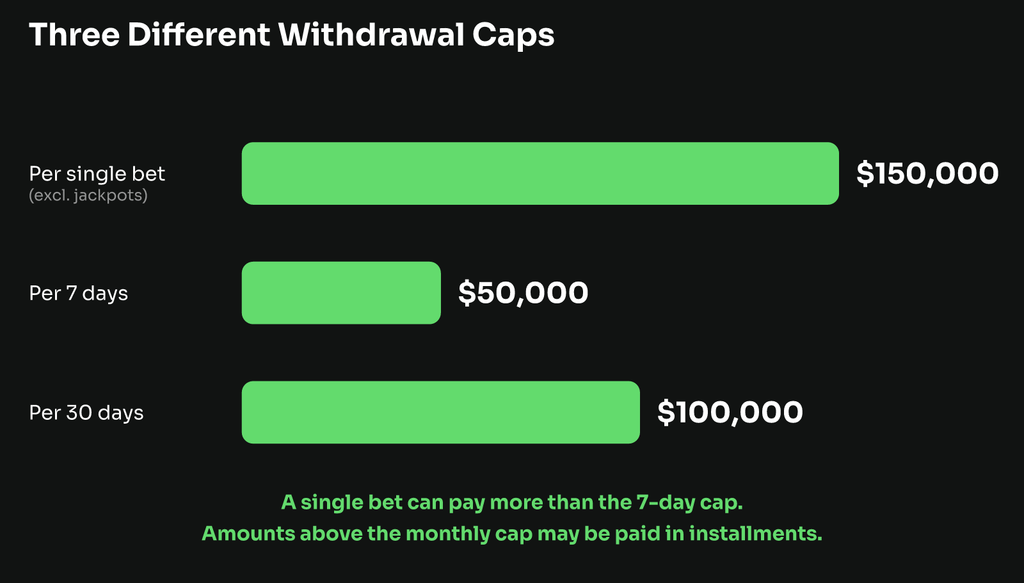
Withdrawals are capped, though. Independent reviews of Jack’s cashier report caps of $50,000 per 7 days and $100,000 per 30 days, with a single-bet payout ceiling of $150,000 outside progressive jackpots; Jack reportedly pays out anything above the monthly cap in further monthly installments. The published SLA allows up to 24 hours for withdrawal processing, but independent testing has clocked typical crypto withdrawals at 10 to 18 minutes.
Does Jack.com Accept Fiat or Card Deposits?#
Jack’s cashier accepts fiat as a funding method, not as an account balance. Independent reviews report a built-in buy-crypto option, run through third-party processor Swapped, that takes Visa, Mastercard, Apple Pay, Google Pay, and a long list of regional bank-transfer and e-wallet methods. That option converts the payment into one of Jack’s 17 supported coins before it reaches your balance: a card-to-crypto on-ramp, not a fiat casino wallet. Withdrawals go the other way only in crypto, so a card or bank account is never the destination.
FAQ#
How many cryptocurrencies does jack.com support?
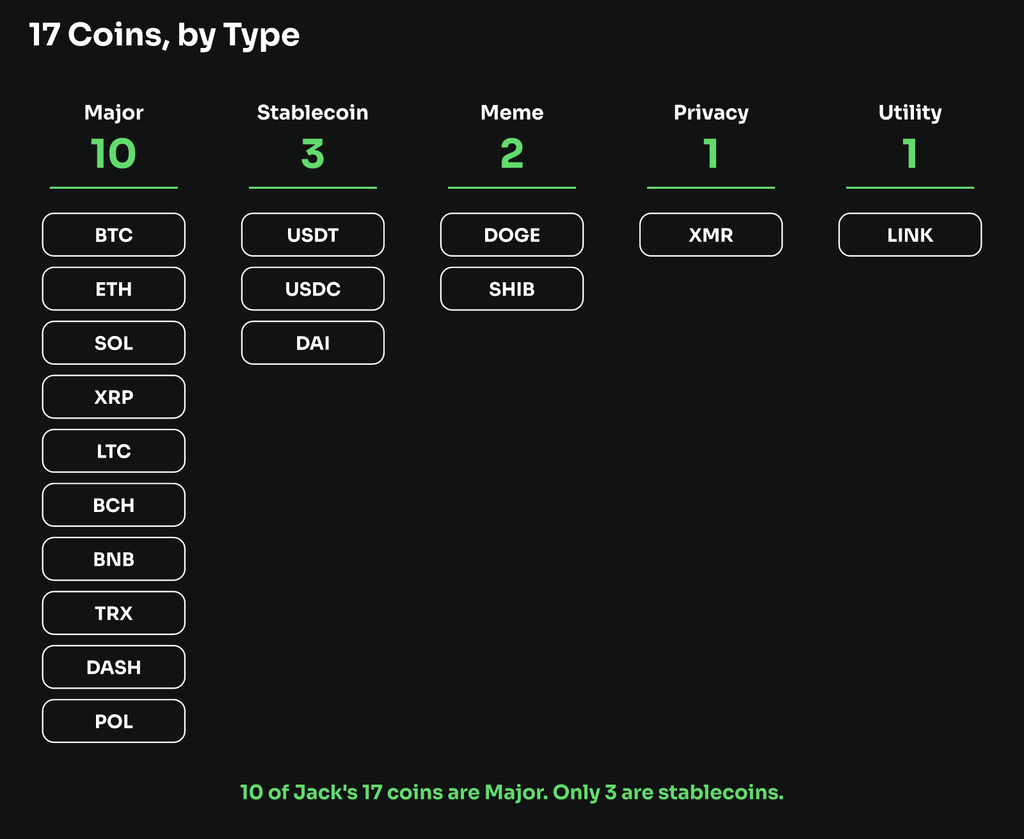
17. The list spans major coins (BTC, ETH, SOL, XRP, LTC, BCH, DOGE, BNB, TRX, DASH), stablecoins (USDT, USDC, DAI), and smaller tokens (SHIB, LINK, POL, XMR). The balance itself is always crypto; a card and bank-transfer on-ramp exists only to convert fiat into one of those coins.
Can I deposit USDT on any network I want?
Only the networks Jack’s cashier lists for USDT: ERC-20, TRC-20, BEP-20, or Polygon. Mismatching the network between your sending wallet and Jack’s deposit address risks the funds not arriving.
Which network is cheapest for depositing or withdrawing on Jack.com?
Among Jack’s supported networks, Tron (TRC-20), Polygon, BNB Smart Chain, and Solana carry lower transaction fees than Ethereum (ERC-20). For USDT or USDC specifically, TRC-20 or Polygon is typically the cheaper choice.
The Bottom Line#
The cryptocurrencies jack.com supports cover enough ground that most players will find their coin of choice: 12 underlying networks, 17 tokens, and a card on-ramp for anyone starting from fiat. The practical work sits on the sending side: match your wallet’s network to the one you select in Jack’s cashier, and pick a cheaper chain like Tron or Polygon over Ethereum when a coin gives you that option.
None of this is a reason to deposit more than you’d planned to. Crypto’s price swings cut both ways between funding an account and cashing out, so treat deposit size as a budgeting decision, not a betting one, and set that limit before you fund the account.