



Every time you spin a slot or roll dice at an online casino, you’re trusting a black box. The random number generator runs on the casino’s servers, invisible to you. Third-party auditors like eCOGRA issue certificates, but those are snapshots taken at a single point in time, not continuous monitoring. The casino pays the auditor. You have no way to test anything between audit cycles.
Provably fair gambling solves this by replacing trust with math.
What Does “Provably Fair” Actually Mean?#
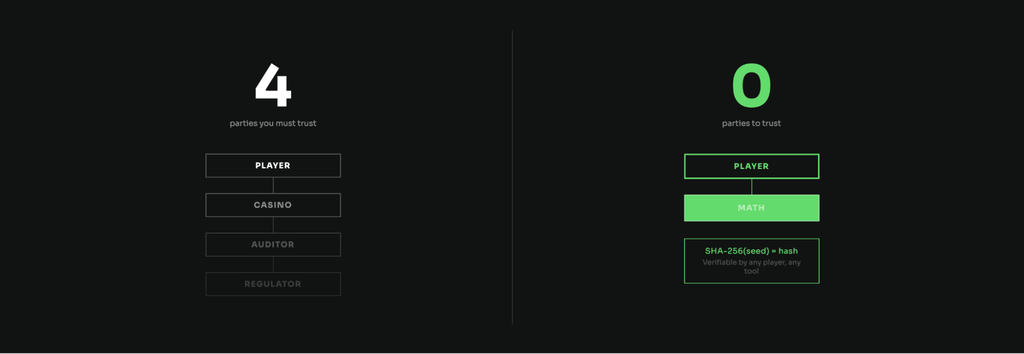
Provably fair is a cryptographic verification system that lets players independently confirm whether a game result was generated according to the stated algorithm, and whether it was altered after the bet was placed. It doesn’t require trust in the operator, the regulator, or an auditor’s certificate. You run the numbers yourself.
The technology has been around since roughly 2012, when Bitcoin gambling developers first adapted cryptographic commitment schemes to prove a dice result couldn’t be changed retroactively. Most major crypto casinos now include it. Choosing a provably fair casino means that tool is available to you for every in-house bet, not just on request.
One clarification before going further: provably fair applies to deterministic in-house games (dice, crash, plinko, limbo) where every outcome can be recomputed from a set of inputs. Slots and live dealer tables from third-party providers like NetEnt or Evolution use those studios’ own certified RNG systems. A casino can host both legitimately; the label applies where the operator controls the code, not where the game belongs to a third-party studio.
How Does Provably Fair Verification Work?#
The system runs on three variables.
Server seed. A random value generated by the casino before a round begins. Critically, the casino doesn’t show you the seed itself; it shows you a hashed version. That hash is a commitment: it proves the casino had a seed before you bet, without revealing it in a way that would let you predict the outcome.
Client seed. A random value contributed by you, the player. You can usually change it in the game’s settings at any time. Including the player’s input in the calculation means neither side fully controls the result.
Nonce. A counter that increments by one with each bet played under the same seed pair. It ensures that running the same seeds through consecutive rounds produces a different result each time.
When you place a bet, the casino software combines all three values using HMAC-SHA256, a cryptographic algorithm that produces a fixed-length string of characters. That string maps to a game outcome: a dice roll, a crash multiplier, a card drawn. Same inputs, same output, every time. And because SHA-256 is a one-way function, knowing the hash in advance tells you nothing about the seed beneath it.
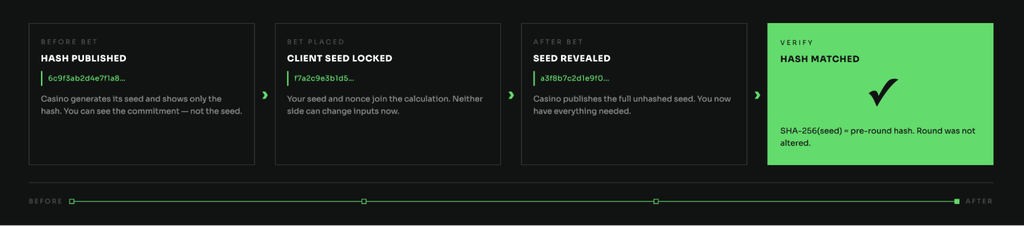
Here’s the sequence in practice:
- Before the round: the casino publishes the hashed server seed. You see the hash, not the seed.
- You place your bet (locking in the client seed and nonce).
- After the round: the casino reveals the unhashed server seed.
- You run the revealed seed through any SHA-256 calculator (dozens of free browser-based tools exist) and confirm the output matches the hash from step one.
- If the hashes match, the casino committed to that seed before the round. The result was not changed.
| Factor | Traditional RNG Casino | Provably Fair Casino |
| Who verifies fairness? | Third-party auditor | Any player, independently |
| Verification timing | Periodic audit cycles | Real time, after every bet |
| Player input to outcome | None | Yes (client seed) |
| Can manipulation be hidden? | Theoretically impossible to prove either way | Mathematically impossible to hide |
| Requires trust in | Regulator + auditor + casino | Cryptographic math |
How to Verify a Bet Yourself#
You don’t need to verify every bet. Running through it once on a small stake is enough to confirm an operator isn’t just displaying the label.
Step 1. Find the fairness page. Look for a “Provably Fair” tab in the casino navigation or within the game interface itself. The documentation should name the exact algorithm: HMAC-SHA256, not just “blockchain technology.”
Step 2. Before playing, note the hashed server seed. Most platforms display it prominently within the game panel; it’s also retrievable from your bet history after the fact.
Step 3. Play a round. Record the client seed and the nonce displayed in the game.
Step 4. After the round, retrieve the revealed server seed from your bet history.
Step 5. Hash-check it. Open a SHA-256 calculator that’s entirely independent of the casino (a generic browser tool, not the operator’s own verifier) and input the revealed server seed. The output should match the pre-round hash exactly.
Step 6. Recompute the outcome. Better platforms provide an in-browser verifier that accepts all three inputs and shows the intermediate computation, not just a pass/fail badge.
If the hashes don’t match, the casino changed the seed after the round ended. That’s evidence of manipulation. If they match and the outcome recomputes correctly from those inputs, the round was clean.
Watch for these specific red flags:
- “Provably fair” appears in marketing copy but not in the game interface
- No pre-round server seed hash is displayed or accessible
- The verification tool always returns “valid” without showing any computation
- Client seed input is not available (you have no contribution to the outcome)
- Bet history doesn’t include seeds, nonces, or timestamps
Does Jack Use Provably Fair? Here’s What the Evidence Shows#
Jack (jack.com) is a crypto casino and sportsbook operated by Data Link Digital B.V. (Curaçao Company No. 164124), holding a CGA direct license (OGL/2024/1562/1139, issued May 15, 2026). This is the same operator that previously ran the platform under the Jackbit name, before rebranding on May 29, 2026. The platform runs on a crypto-native wallet, supports 17+ cryptocurrencies, and carries no fiat payment options.
On provably fair: two recent post-rebrand reviews (vip-grinders.com, somuchpoker.com) report that Jack’s in-house instant games library includes SHA-256 provably fair verification, with a dedicated Provably Fair tab that accepts client seed inputs and allows players to reproduce and check individual results. Titles in that category include Dice, Plinko, and Limbo.
Editorial note for fact-check before publication: One post-rebrand review (kryptocasinos.com, assessed approximately one month after the rebrand) states that Jack’s in-house originals are not provably fair and results cannot be verified on-chain. Two other recent reviews (vip-grinders.com, somuchpoker.com) report the opposite. This conflict is unresolved in the current draft; verify directly with Jack’s team before publishing this section.
What’s clearly not provably fair at Jack, and shouldn’t be expected to be: the 7,000+ titles from third-party providers like Evolution, NetEnt, and Pragmatic Play. Those games run on the studios’ own certified RNG systems. That’s standard across every crypto casino; it’s not a gap unique to Jack.
Jack’s CGA direct license, issued under Curaçao’s December 2024 regulatory overhaul, means Data Link Digital B.V. is answerable directly to the regulator rather than operating under a sub-licensed master operator, as was common in the old Curaçao model. That’s a structural improvement on what came before, even if the CGA remains less stringent than MGA or UKGC standards on consumer protections. Provably fair and a direct license serve different purposes: the first covers individual game outcomes; the second covers the operator as an institution.
What Else Should You Check at a Provably Fair Crypto Casino?#
Provably fair covers one specific question: were individual game outcomes generated fairly? It doesn’t answer anything else about an operator. Before playing at any provably fair casino, check these alongside the fairness documentation:
- License status. A direct CGA license is verifiable on the Curaçao Gaming Authority register. MGA and UKGC licenses carry stricter consumer protections.
- Complaint history. Platforms like AskGamblers track formal complaints and resolution rates. Delays on large withdrawals are common across licensed crypto casinos; refusals to pay are a different category.
- Payout track record. Independently tested withdrawal times matter more than the stated SLA ceiling.
- Responsible gambling tools. Deposit limits, session timers, and self-exclusion should be accessible from account settings without a support ticket.
The Practical Takeaway#
Provably fair gambling moves verification from the regulator’s desk to yours. The math is accessible to anyone with five minutes and a browser-based SHA-256 calculator, and it’s the clearest available evidence that a game result wasn’t changed after you placed your bet. It doesn’t replace checking a platform’s license, complaint history, and withdrawal record. Traditional casino models have no equivalent.
If gambling is affecting you or someone you know, most licensed operators provide deposit limits, session timers, and self-exclusion tools in account settings. The National Council on Problem Gambling helpline is available at 1-800-522-4700.
Frequently Asked Questions#
Is provably fair the same as an RNG audit?
No. An RNG audit is a third-party review conducted on a periodic schedule; results aren’t publicly accessible and must be taken on trust. Provably fair is a player-side verification process running in real time on every individual bet, using publicly visible cryptographic math. Both aim to prove outcomes are random and untampered, but provably fair removes the auditor from the equation entirely.
Can a casino fake a provably fair system?
A casino could theoretically display a verifier that returns a positive result regardless of inputs. The safeguard: the computation should be reproducible with a completely independent SHA-256 tool outside the casino’s control. If a casino’s hash values can’t be independently verified with a standard browser calculator, treat that as a red flag. Legitimate implementations name the exact algorithm and show intermediate computation steps.
Does “provably fair” mean a casino is completely safe?
Provably fair means individual game outcomes are mathematically verifiable. It says nothing about payout speeds, bonus terms, or fund security. It’s one input among several; use it alongside license verification, complaint history, and payout track record rather than as a complete due-diligence checklist.
Does provably fair apply to live dealer games and slots?
No. Provably fair applies only to in-house deterministic games such as dice, crash, plinko, and limbo, where the casino controls the code and every outcome can be recomputed from the three seed inputs. Live dealer tables and slots from third-party studios like Evolution or Pragmatic Play run on those providers’ own certified RNG systems. The casino platform hosts those games but doesn’t control the underlying code, so it can’t apply its own verification protocol on top. Any site claiming that all its games are provably fair is worth examining more closely.
Can I change my client seed, and does it affect the game?
Yes, and you can do it at any time in the game’s settings, typically before starting a new round. Changing your client seed doesn’t affect the house edge or improve your statistical odds. What it does is ensure the casino can’t predict your input in advance. Using the same client seed across a long session means anyone with prior access to that seed could theoretically predict future outcomes from the same seed pair. Rotating it periodically is a simple precaution, and the option to change it is what makes the system two-sided rather than controlled entirely by the casino.